Best Way to Exchange Euros Without Fees (2025 Guide) The best way to exchange euros without fees is to let your bank or card network handle the conversion, avoid dynamic currency conversion, and use fee-transparent ATMs or transfer services instead of exchange counters. Most people lose money not because of bad timing—but because of how they exchange.
FAQs Exchange Euros Without Fees
Conclusion Exchange Euros Without Fees
The Short Answer (Featured-Snippet Ready)
To exchange euros without fees, decline dynamic currency conversion, use ATMs that don’t add local surcharges, and let your bank or card network convert at the wholesale rate. Avoid exchange counters and “guaranteed rate” offers.
Where Most “Fees” Actually Come From
Many people look only for a visible “fee” line. That’s a mistake.
Most currency losses come from:
bad exchange rates, not labeled fees,
dynamic currency conversion (DCC),
wide spreads hidden inside the rate,
ATM surcharges that aren’t clearly explained.
A “zero-fee” exchange can still be expensive if the rate is bad.
Best Way to Exchange Euros Without Fees (2025 Guide)
The best way to exchange euros without fees is to let your bank or card network handle the conversion, avoid dynamic currency conversion (DCC), and use fee-transparent ATMs or digital transfer services instead of traditional exchange counters. Many travelers lose money not because of bad timing or fluctuating rates, but because of the method they choose. Even “no fee” signs can hide high costs in the exchange rate.
The Short Answer (Featured-Snippet Ready)
To exchange euros without fees:
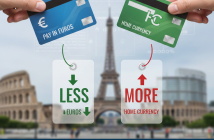
Decline dynamic currency conversion (DCC) — always pay or withdraw in euros, not your home currency.
Use bank-branded ATMs or card networks — these usually apply the wholesale or interbank rate.
Avoid airport or hotel exchange counters — even with “guaranteed rates,” they often include hidden spreads.
Consider online transfer services for large or recurring conversions — transparent fees and tighter spreads save money.
Where Most “Fees” Actually Come From
Many people focus only on the visible line item labeled “fee,” assuming that’s the total cost. This is a mistake. Most currency losses are hidden:
Bad exchange rates — Even if the fee is zero, a poor rate can cost several percent of the transaction.
Dynamic currency conversion (DCC) — Paying in your home currency abroad can add 3–10% extra in hidden costs.
Wide spreads inside the exchange rate — Exchange counters often include a margin above the real market rate.
ATM surcharges — Some machines add local fees that aren’t clearly displayed.
In other words, a “zero-fee” exchange can still be expensive if the rate is far from the wholesale benchmark.
Comparing the Main Methods
1. Cash Exchange Counters
Almost always the most expensive.
Wide spreads, poor transparency, and captive customer locations like airports make them costly.
2. Bank-Branded ATMs
Usually offer near-market rates with clear or no fees.
Always withdraw in euros, not your home currency.
Avoid private tourist ATMs—they may charge high local fees.
3. Cards (Credit or Debit)
Best for day-to-day payments if no foreign transaction fee applies.
Always choose to pay in euros; decline DCC prompts.
Transparent and convenient for small transactions.
4. Online Transfers & Multi-Currency Accounts
Ideal for larger amounts or recurring payments (rent, tuition, invoices).
Tight spreads, explicit fees, and centralized conversions make this cheaper than banks or cash.
Step-by-Step Guide to Avoid Fees
Check your card’s foreign transaction fees before traveling.
Use bank ATMs for cash needs and withdraw in euros.
Always decline dynamic currency conversion if offered.
Avoid airport and hotel exchange counters, except for small emergency amounts.
Compare online transfer services for larger conversions.
Split large exchanges if needed; don’t convert everything at once.
Following this method ensures that you minimize both visible and hidden costs while keeping your funds secure.
Key Takeaways
“No fee” does not always mean cheap. Total cost depends on the exchange rate and hidden spreads.
ATMs and cards using your bank or card network almost always beat traditional counters.
Timing the market matters less than choosing the right method. A smart method at an average rate usually beats perfect timing at a bad rate.
For frequent or large transfers, digital services with transparent fees can save hundreds of dollars over time.
In short, exchanging euros without fees isn’t about predicting currency moves—it’s about avoiding expensive systems and choosing transparent, reliable methods. With careful planning, you can protect your money automatically and avoid the costly mistakes most travelers make.
If you want, I can also create an SEO-ready external link list and a URL that includes your focus keyword so this 2025 guide is optimized for Google search. Do you want me to do that next?