Introduction Dynamic Currency
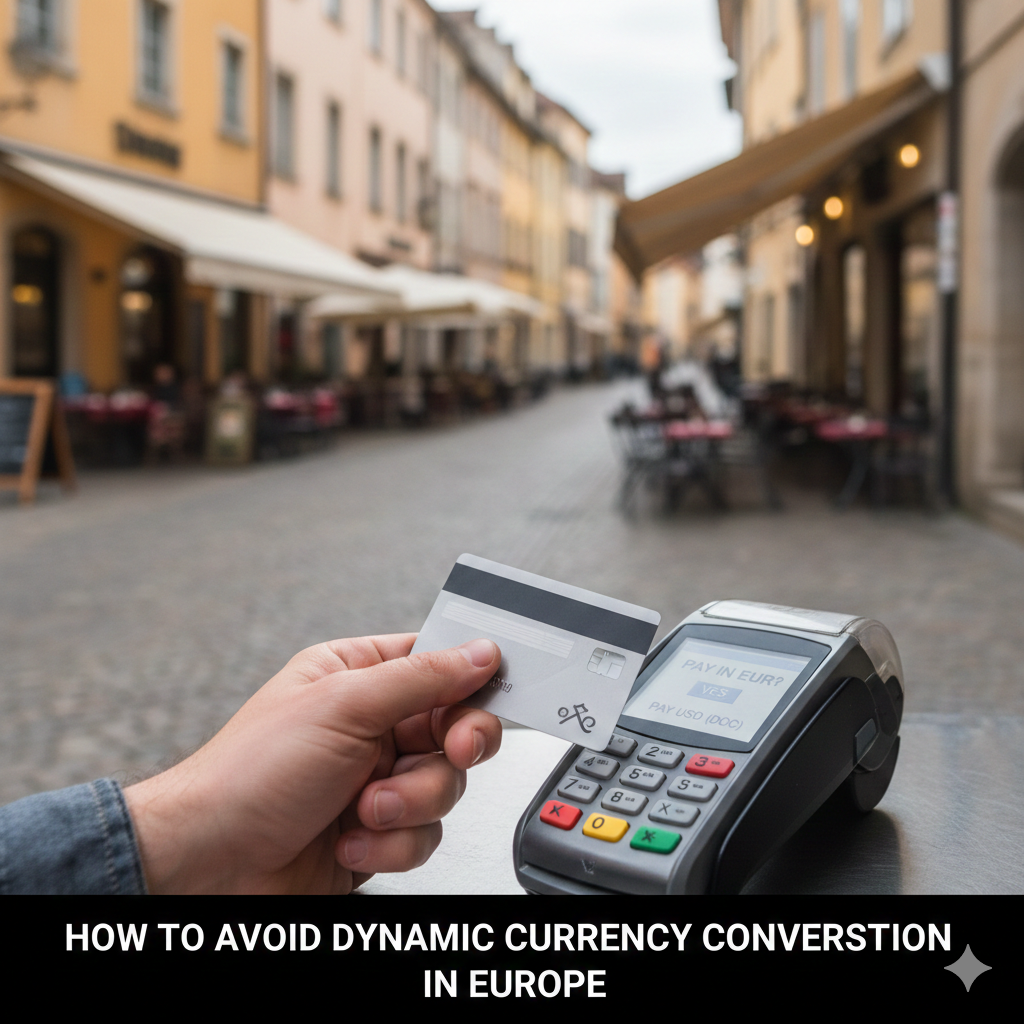
To avoid dynamic currency conversion (DCC) in Europe, you must always choose to pay or withdraw in euros and decline any “conversion” or “guaranteed rate” offer. DCC is one of the most expensive and common money traps for travelers—and it works precisely because it looks helpful.
This topic matters because DCC doesn’t feel like a scam. It’s presented as a convenience feature at checkout screens, ATMs, hotels, and taxis. But convenience comes at a price. The markup is often invisible, the wording is misleading, and the cost adds up quietly over an entire trip. Learning to recognize and reject DCC gives you instant, repeatable savings—without tracking exchange rates or timing the market.
Table of Contents
The short answer (featured snippet)
What dynamic currency conversion actually is
Why DCC exists and who profits from it
Where you’ll encounter DCC most often
ATM screens: what to press and what to avoid
Card terminals: decoding confusing prompts
Information Gain: the psychology behind DCC traps
Practical table: DCC vs normal conversion
Common mistakes and how to fix them
UNIQUE: Beginner mistake most travelers make
A simple DCC-avoidance checklist
FAQs Dynamic Currency
Conclusion Dynamic Currency
- The Short Answer (Featured-Snippet Ready)
You avoid dynamic currency conversion in Europe by always selecting EUR, declining conversion offers, and letting your bank or card network handle the exchange rate.
- What Dynamic Currency Conversion Actually Is
Dynamic currency conversion is a service that:
converts your payment into your home currency at the point of sale or ATM,
applies a markup to the real exchange rate,
locks in that worse rate immediately.
Instead of your bank converting euros at a competitive rate, the merchant or ATM provider controls the exchange—and profits from it.
The markup is commonly:
3–6%,
sometimes higher in tourist-heavy areas,
rarely explained clearly.
[Expert Warning]
DCC is optional—but many screens are designed to make it feel mandatory.
- Why DCC Exists (And Who Profits)
DCC exists because it’s extremely profitable.
Merchants earn a commission
ATM operators earn a cut
Payment processors share the revenue
Your bank earns nothing from DCC—which is why banks generally advise customers to avoid it.
The more confused or rushed you are, the more likely DCC succeeds.
- Where You’ll Encounter DCC Most Often
You’ll see DCC prompts in:
ATMs (especially private or tourist ATMs)
card terminals in hotels and restaurants,
taxis and car rentals,
online bookings based in Europe.
DCC is especially common in:
airports,
major tourist cities,
late-night or high-traffic venues.
- ATM Screens: What to Press and What to Avoid
ATMs are the most common DCC trap.
Typical prompt:
“Withdraw €200 or $215?”
What to do
Choose €200
Decline conversion
Continue in local currency
What to avoid
“Withdraw in home currency”
“Accept conversion”
“Guaranteed amount”
[Pro-Tip]
If an ATM shows two currency options, the cheaper one is almost always the local currency (EUR).
- Card Terminals: Decoding Confusing Prompts
Card terminals may show:
two buttons (EUR vs home currency),
a checkbox with preselected conversion,
a verbal prompt from the cashier.
Some terminals default to home currency unless you intervene.
What to say
“Please charge in euros.”
What to watch for
buttons labeled “recommended”,
unclear wording,
screens turned away from you.
[Money-Saving Recommendation]
Always watch the terminal until the transaction is confirmed. If you don’t see “EUR,” stop and ask.
- Information Gain: The Psychology Behind DCC Traps
Most articles explain how DCC works. Few explain why it works so well.
DCC succeeds because it leverages:
familiarity bias (home currency feels safer),
loss aversion (“what if the rate gets worse?”),
decision fatigue (travel is tiring).
The screen isn’t neutral—it’s optimized to push the option that earns more money.
Once you understand this, the trap becomes obvious—and easy to avoid.
- Practical Table: DCC vs Normal Conversion
| Feature | Dynamic Currency Conversion | Normal EUR Conversion |
| Who sets the rate | Merchant / ATM | Your bank / card network |
| Exchange rate | Marked up | Near market |
| Transparency | Low | High |
| Typical cost | High | Low |
| Recommended | ❌ No | ✅ Yes |
- Common Mistakes and How to Fix Them
Mistake 1: Choosing the familiar currency
Fix: Familiarity costs money—choose euros.
Mistake 2: Trusting “recommended” options
Fix: Recommended for them, not for you.
Mistake 3: Letting the cashier decide
Fix: Be explicit: “Euros only.”
Mistake 4: Assuming small purchases don’t matter
Fix: DCC compounds quickly across many transactions.
[Expert Warning]
DCC rarely appears as a “fee.” It appears as a choice.
- UNIQUE SECTION — Beginner Mistake Most Travelers Make
The most common beginner mistake is assuming:
“If it’s offered on the screen, it must be fair.”
In reality, DCC is offered because it’s profitable, not because it helps you. Once you internalize that, declining it becomes automatic.
- A Simple DCC-Avoidance Checklist
Before every transaction:
✔ Choose EUR
✔ Decline conversion
✔ Ignore “guaranteed” language
✔ Watch the terminal screen
✔ Check your receipt for “DCC”
This checklist alone can save hundreds over multiple trips.
YouTube Embed (Contextual & Playable)
Embed an educational video such as:
“Dynamic Currency Conversion Explained (How to Avoid It)”
Choose a consumer-finance or travel-education channel that shows real ATM and checkout examples.
- FAQs (Schema-Ready)
What is dynamic currency conversion?
A marked-up currency conversion offered at checkout or ATMs.
Is DCC mandatory in Europe?
No—it’s always optional.
Do all ATMs use DCC?
No, but many private and tourist ATMs do.
Can I get refunded if I accept DCC?
Usually no—DCC is considered consented.
How do I know if DCC was applied?
Check your receipt or statement for “DCC” or a poor rate.
- Conclusion
Dynamic currency conversion is one of the easiest money traps to avoid—and one of the most profitable for merchants. It relies on confusion, fatigue, and familiarity to work.
If you remember one habit while traveling in Europe, make it this: always choose euros and decline conversion offers. It’s a simple decision that protects your money every time.
internal link
https://dailyeuros.com/index.php/2026/01/09/pay-in-euros
external link
https://www.forbes.com/advisor/credit-cards/what-is-dynamic-currency-conversion/