Introduction Home Currency
Should You Pay in Euros or Your Home Currency Abroad?
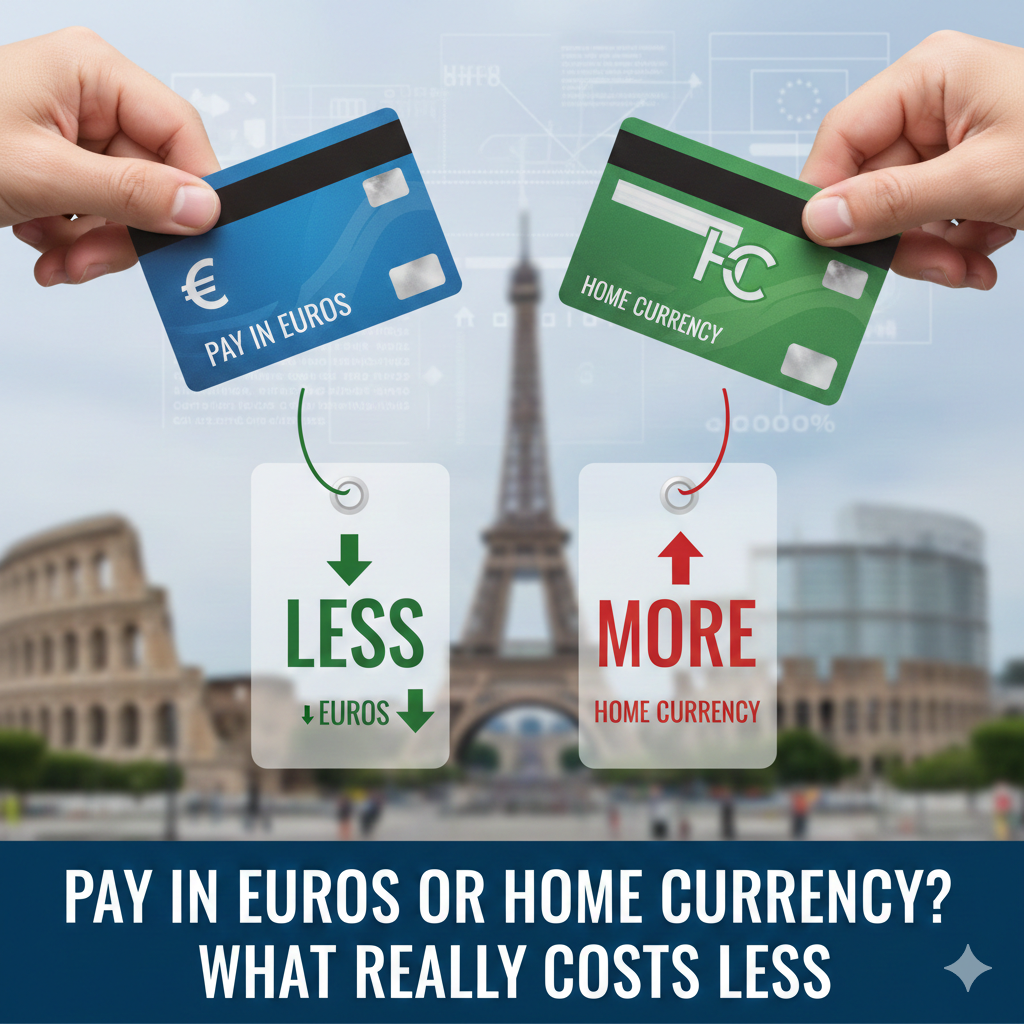
You should almost always pay in euros, not your home currency, when traveling in Europe. Paying in your home currency usually triggers dynamic currency conversion (DCC)—a convenience feature that quietly applies a worse exchange rate. The result: you pay more without realizing it.
This matters because the choice often appears at the worst moment—standing at a checkout, tired, rushed, and unsure. The screen offers reassurance: “Pay in your home currency—guaranteed rate.” It feels safe. But that safety is expensive. Understanding how this system works helps you avoid one of the most common—and costly—travel money mistakes.
FAQs Home Currency
Conclusion Home Currency
- The Short Answer (Featured-Snippet Ready)
Paying in euros is almost always cheaper than paying in your home currency because it lets your bank or card network convert at a better rate, avoiding dynamic currency conversion markups.
- What Happens When You Choose Your Home Currency
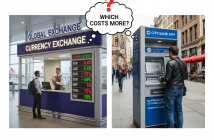
When you choose your home currency at a terminal or ATM:
the merchant or ATM provider controls the exchange,
a markup is added to the real rate,
the final cost is locked in immediately.
This is dynamic currency conversion. It’s legal, common, and very profitable for providers—but rarely favorable for you.
The markup is often:
3–6%,
sometimes higher in tourist areas,
rarely disclosed clearly.
[Expert Warning]
If a terminal asks you to pay in your home currency, it’s not doing you a favor—it’s selling you an expensive service.
- What Happens When You Pay in Euros
When you pay in euros:
your card network or bank handles conversion,
the rate is usually close to the interbank rate,
any foreign transaction fee is clearly defined.
Even with a small foreign transaction fee, this option is almost always cheaper than DCC.
Why banks are cheaper here
Banks and card networks compete on FX efficiency. Merchants don’t—they monetize convenience.
[Pro-Tip]
Paying in euros gives control to the party that usually offers the best rate: your bank or card network.
- Why “Guaranteed Rate” Is Misleading
“Guaranteed” sounds safe. But guaranteed against what?
It means:
the rate won’t change after the transaction,
not that the rate is good.
In volatile markets, DCC providers market certainty. But that certainty comes with a built-in premium. You’re paying extra to eliminate a risk that often doesn’t matter.
[Money-Saving Recommendation]
Accepting normal FX variability is cheaper than paying for artificial certainty.
- When Paying in Home Currency Might Make Sense
There are rare exceptions.
Paying in your home currency may make sense if:
your card has extremely high foreign transaction fees, and
you’ve confirmed the DCC markup is unusually low (rare).
For most travelers, this combination doesn’t exist. Even high card fees are usually lower than DCC markups.
- Information Gain: Who Actually Controls the Exchange Rate
Most articles don’t explain this clearly.
Pay in euros:
→ Your bank/card network sets the rate
Pay in home currency:
→ Merchant or ATM provider sets the rate
That’s the entire decision in one line.
Merchants aren’t FX specialists. They use third-party systems designed to maximize revenue from conversion—not fairness.
Once you understand who controls the rate, the cheaper choice becomes obvious.
- Practical Table: Euro vs Home-Currency Payments
| Choice | Who Sets the Rate | Typical Cost | Transparency | Best Option? |
| Pay in euros | Your bank/network | Low | Good | ✅ Yes |
| Pay in home currency | Merchant/ATM | High | Poor | ❌ No |
- Common Mistakes and Fixes
Mistake 1: Choosing familiar currency
Fix: Familiarity costs money—choose euros.
Mistake 2: Trusting the screen recommendation
Fix: Always read carefully and decline conversion.
Mistake 3: Thinking small purchases don’t matter
Fix: Small DCC fees add up quickly.
Mistake 4: Letting cashiers choose for you
Fix: Say clearly: “Charge in euros, please.”
[Expert Warning]
If you don’t actively choose euros, the system may choose home currency for you.
- UNIQUE SECTION — Real-World Checkout Scenario
You’re at a café. The terminal flips toward you:
“Pay €18.40 or $20.35?”
You choose dollars. It feels easier.
What happened:
the café’s processor added a hidden markup,
your bank never touched the conversion,
you paid more than necessary.
Multiply this by dozens of transactions over a trip, and the loss becomes noticeable.
- How to Always Choose the Cheaper Option
Use this simple checklist:
Always select EUR
Decline “conversion” or “guaranteed rate” offers
Watch for confusing button layouts
Speak up if a cashier chooses for you
Check your receipt—look for “DCC
This habit alone can save more money than chasing exchange rates.
YouTube Embed (Contextual & Playable)
Embed an educational explainer such as:
“Dynamic Currency Conversion Explained (Avoid Overpaying)”
Choose a consumer-finance or travel-education channel that demonstrates real checkout examples.
- FAQs (Schema-Ready)
Is it always cheaper to pay in euros?
Almost always, yes.
What is dynamic currency conversion?
A service that converts at a marked-up rate.
Do ATMs also use DCC?
Yes, if you choose your home currency.
Can I disable DCC on my card?
No, but you can always decline it.
Does paying in euros affect refunds?
No—refunds follow the original currency.
- Conclusion
Paying in euros instead of your home currency is one of the simplest, most reliable ways to avoid hidden travel costs. Dynamic currency conversion sells certainty—but charges heavily for it.
If you remember one rule abroad, make it this: always choose euros. It’s a small decision that consistently saves money, reduces regret, and keeps control where it belongs—with you.
Internal link
https://dailyeuros.com/index.php/2026/01/09/best-way-to-transfer
External link
https://wise.com/us/send-money/send-money-to-europe?utm_source