Introduction
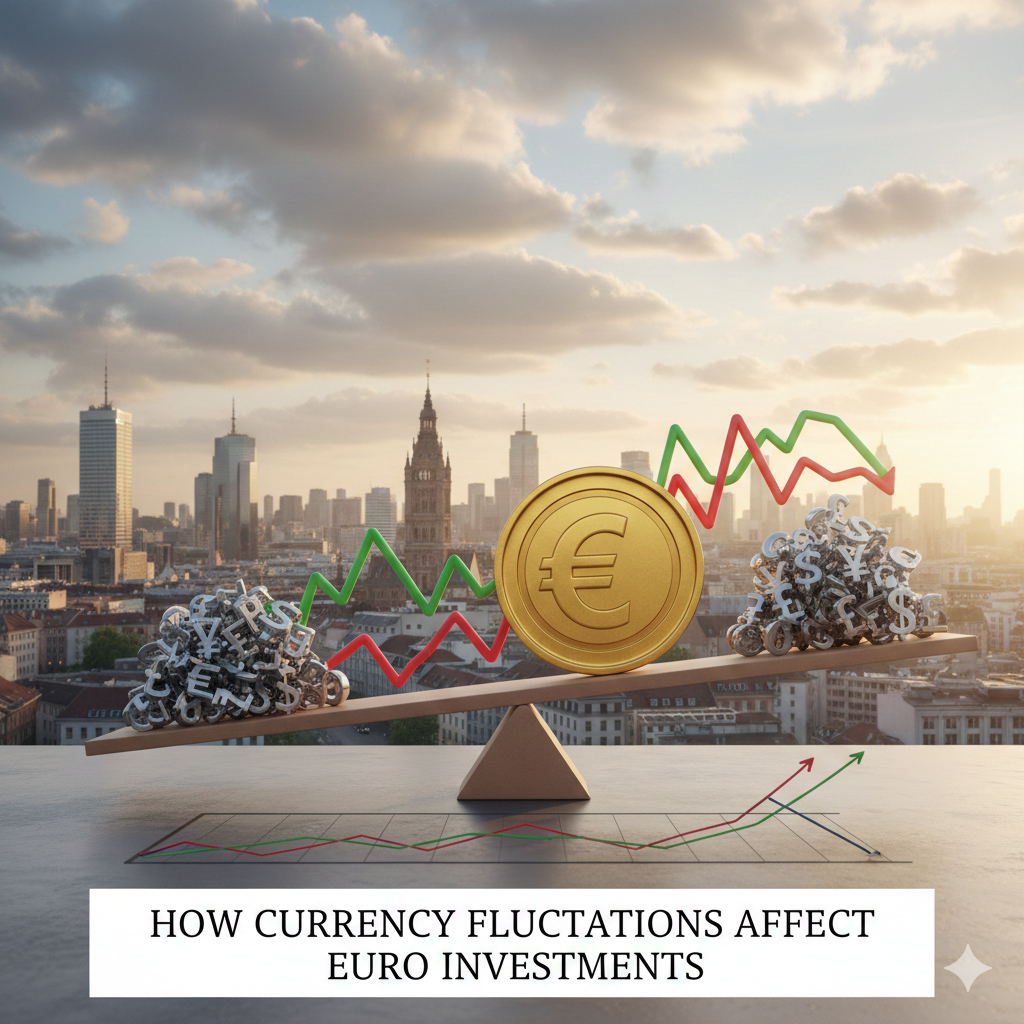
How Currency Fluctuations Affect Euro Investments
Currency fluctuations affect euro investments by amplifying or reducing returns when measured in your home currency, even if the underlying assets perform well. This effect can feel confusing because nothing “went wrong” with the investment—yet your results still changed.
This matters because many investors underestimate currency impact. They focus on stock or bond performance and ignore exchange rates until returns look disappointing or unexpectedly strong. In reality, currency is a second performance layer, not a side detail. Understanding when it matters—and when it doesn’t—helps you stay calm, avoid overreacting, and make better long-term decisions.
The Short Answer (Featured-Snippet Ready) Currency Fluctuations
Currency fluctuations affect euro investments by changing their value when converted back to your home currency, but over long periods, asset performance usually matters more than exchange-rate movement.
- What Currency Fluctuation Really Means Currency Fluctuations
- https://youtu.be/JwvpFvHhmpE
When you invest in euro-denominated assets, two things happen at once:
the asset’s value changes in euros, and
the euro’s value changes relative to your home currency.
Your final return equals investment performance × currency movement.
This means:
strong euro + rising asset = boosted returns,
weak euro + rising asset = muted returns,
strong euro + falling asset = reduced losses.
Currency doesn’t replace performance—it modifies it.
- When Currency Helps Your Euro Investments Currency Fluctuations
Currency works in your favor when:
the euro strengthens against your home currency,
you convert gains back after appreciation,
you earn income in euros but spend in another currency.
In these cases, even modest asset gains can look impressive once converted.
However, relying on currency strength alone is speculative. It’s a tailwind—not a strategy.
[Expert Warning]
Currency gains feel rewarding, but they’re unreliable as a primary return driver.
- When Currency Hurts Your Euro Investments Currency Fluctuations
Currency hurts returns when:
the euro weakens after you invest,
your asset performs well but FX offsets gains,
you panic-sell during currency dips.
This is where frustration sets in. Investors often blame the investment rather than the currency layer.
The mistake isn’t exposure—it’s reacting emotionally to FX noise.
[Pro-Tip]
Judge euro investments first in euros, then in your home currency.
- Short-Term vs Long-Term Currency Impact Currency Fluctuations
Short-Term
Currency moves can dominate returns:
volatile,
news-driven,
emotionally disruptive.
Short-term FX exposure can feel like gambling if you’re not prepared.
Long-Term
Over long periods:
currency effects tend to fluctuate both ways,
asset fundamentals dominate outcomes,
timing currency becomes extremely difficult.
This is why long-term investors often tolerate unhedged exposure.
[Money-Saving Recommendation]
Long-term investors usually benefit more from consistency than from currency control.
- Hedged vs Unhedged Euro Investments Currency Fluctuations
Unhedged Investments
Pros
simple structure,
lower costs,
natural diversification.
Cons
short-term FX volatility.
Hedged Investments
Pros
reduced currency swings,
smoother short-term returns.
Cons
higher costs,
imperfect hedging,
reduced upside during favorable FX moves.
Hedging is a tool, not a default solution.
- Information Gain: Why Currency Fear Is Often Exaggerated Currency Fluctuations
Many investors overestimate currency risk because:
FX moves are visible and headline-driven,
returns are reported in home currency,
losses feel “external” and unfair.
What’s often missing from top articles is this reality:
Currency risk matters most when your investment horizon is short or your cash needs are fixed.
For long-term growth investors, currency noise usually fades behind fundamentals.
- Practical Table: FX Impact Scenarios Currency Fluctuations
| Scenario | Asset Performance | Euro Movement | Result |
| Rising asset + strong euro | Up | Up | Strong gains |
| Rising asset + weak euro | Up | Down | Reduced gains |
| Falling asset + strong euro | Down | Up | Losses softened |
| Falling asset + weak euro | Down | Down | Larger losses |
- Common Mistakes and Fixes Currency Fluctuations
Mistake 1: Blaming investments for FX losses
Fix: Separate asset and currency performance.
Mistake 2: Hedging too early
Fix: Understand costs before hedging.
Mistake 3: Panic-selling during FX drops
Fix: Stick to your time horizon.
Mistake 4: Expecting currency predictions to work
Fix: Accept uncertainty.
[Expert Warning]
Currency timing is harder than stock timing—and stock timing is already hard.
- UNIQUE SECTION — Real-World Investor Scenario Currency Fluctuations
An investor buys a eurozone ETF. The ETF rises steadily in euros, but the euro weakens against their home currency. Returns look flat.
They sell, frustrated.
Months later:
the euro recovers,
the ETF continues growing,
they missed both gains.
The issue wasn’t the investment—it was reacting to temporary FX movement.
- How to Think About Currency Risk Rationally Currency Fluctuations
Ask these questions:
What is my time horizon?
Will I need this money soon?
Does my spending currency match my investment currency?
Am I reacting to noise or fundamentals?
Currency risk becomes manageable once it’s contextualized.
- FAQs (Schema-Ready) Currency Fluctuations
Do currency fluctuations affect all euro investments?
Yes, when measured in another currency.
Should beginners hedge euro investments?
Usually no.
Can currency gains offset poor investments?
Temporarily, but not reliably.
Does FX matter more for bonds or stocks?
Often more for bonds due to lower returns.
Is currency risk avoidable?
Not entirely—only manageable.
- Conclusion Currency Fluctuations
Currency fluctuations are a real—but often overstated—part of euro investing. They influence results, but they rarely determine long-term success on their own.
When you understand how FX fits into the bigger picture, you stop reacting emotionally and start investing with clarity. The goal isn’t to eliminate currency risk—it’s to put it in its proper place.
Image Suggestions (1200 × 628 px)
Featured Image Prompt
Create a clean financial illustration showing euro investment charts overlaid with currency exchange arrows rising and falling. Use modern blue-gray tones, subtle motion lines, and title text: “How Currency Fluctuations Affect Euro Investments”.
Internal link
How to Invest in Eurozone Stocks (Beginner Guid
External link
https://www.finra.org/investors/insights/currency-risk-why-it-matters-you?utm_source