Introduction Exchange Dollars to Euros
Cheapest Way to Exchange Dollars to Euros (Avoid Overpaying) The cheapest way to exchange dollars to euros is usually to let your bank or card network handle the conversion at the real market rate, while avoiding exchange counters, dynamic currency conversion, and private tourist ATMs. Most people overpay not because the euro moved—but because they chose an expensive exchange method.
This matters more than ever because exchange options look more “user-friendly” today, but many hide their profit inside the rate. A single bad choice can cost more than several weeks of EUR/USD movement. Whether you’re traveling, paying rent abroad, or sending euros internationally,
FAQs Exchange Dollars to Euros
Conclusion Exchange Dollars to Euros
- The Short Answer (Featured-Snippet Ready)
The cheapest way to exchange dollars to euros is to use a bank-branded ATM or card that converts at the network rate, always choose euros, and avoid exchange counters and “guaranteed rate” offers.
- What “Cheapest” Actually Means
“Cheapest” does not mean:
zero visible fees,
convenience,
or the place with the biggest sign.
Cheapest means:
tight exchange rate (small spread),
minimal or no conversion markup,
predictable fees (or none).
Many services advertise “no commission” while quietly charging through a worse rate.
[Expert Warning]
A bad exchange rate can cost more than a visible fee—and you’ll never see it itemized.
- Comparing Major Ways to Exchange USD to EUR
Most people choose one of these paths:
Exchange cash at a counter
Withdraw euros from an ATM
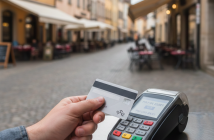
Pay by card in euros
Convert via bank or transfer service
Each has very different cost structures.
- ATMs vs Cash Exchange Counters
Cash Exchange Counters
These are almost always the most expensive option.
Why:
captive customers,
wide spreads,
poor transparency.
Even when they say “no fee,” the rate is often far from the real market rate.
ATMs (The Better Choice)
Bank-branded ATMs usually offer:
closer-to-market rates,
fewer hidden markups,
clearer fee structure.
The key rule:
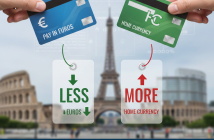
Always withdraw in EUR, never in USD.
Choosing USD triggers dynamic currency conversion, which is one of the costliest mistakes you can make.
[Pro-Tip]
If the ATM asks “Continue with conversion?”, choose No and proceed in euros.
- Cards, Banks, and Online Conversion Options
Cards
Cards are often the cheapest day-to-day option when:
there’s no foreign transaction fee,
you always pay in euros,
the merchant terminal doesn’t force conversion.
For most travelers, card payments in EUR beat cash exchanges easily.
Banks
Traditional banks can be:
reasonable for small amounts,
expensive for larger conversions.
They often add hidden spreads even if fees look low.
Online / App-Based Options
Digital conversion tools and multi-currency platforms often:
use the mid-market rate,
show fees clearly,
beat banks for large or recurring conversions.
[Money-Saving Recommendation]
If you regularly exchange more than a few hundred dollars, comparing transparent online transfer services can save more than timing the market.
- Transfers and Multi-Currency Accounts
For:
rent,
tuition,
freelance invoices,
recurring payments,
cash and cards aren’t ideal.
Dedicated transfer services or multi-currency accounts are often cheapest because:
spreads are tight,
fees are explicit,
conversion is centralized.
They also reduce stress by separating payment timing from exchange timing.
- Information Gain: Why Timing Matters Less Than Method
Many articles obsess over:
“Should I wait for a better rate?”
In practice, method choice matters more than timing for most people.
Why?
A 2% bad rate wipes out weeks of favorable market movement.
DCC alone can cost 3–10%.
Spreads quietly compound.
A smart method at an average rate usually beats a perfect rate with a bad method.
[Expert Warning]
Trying to outguess the market while using expensive exchange tools is the worst of both worlds.
- Practical Table: USD → EUR Cost Comparison
| Method | Typical Cost | Transparency | Best For |
| Airport exchange counter | Very high | Poor | Emergency only |
| Hotel exchange | High | Poor | Avoid |
| Bank branch | Medium | Moderate | Small pre-trip cash |
| Bank-branded ATM | Low | Good | Best cash option |
| Tourist private ATM | Medium–high | Poor | Avoid |
| Card (pay in EUR) | Low | Good | Daily spending |
| Transfer service | Low | Very good | Large/recurring |
- Common Mistakes and How to Fix Them
Mistake 1: Choosing convenience over cost
Fix: Take 2 extra minutes to find a bank ATM.
Mistake 2: Accepting conversion in USD
Fix: Always choose EUR.
Mistake 3: Exchanging everything at once
Fix: Convert in stages.
Mistake 4: Ignoring spread costs
Fix: Compare the rate, not just fees.
[Pro-Tip]
If a service won’t clearly explain how it makes money, assume you’re paying more.
- UNIQUE SECTION — Beginner Mistake Most People Make
The most common beginner mistake is thinking:
“No fee means cheap.”
In reality:
no fee + bad rate = expensive,
small fee + good rate = cheap.
Once you shift your focus from “fees” to total cost, choosing the cheapest method becomes much easier.
- Step-by-Step: Cheapest Practical Process Cheapest Way to Exchange Dollars to Euros (Avoid Overpaying)
Check your card’s foreign transaction fee
Prefer card payments in EUR
Use bank-branded ATMs for cash
Decline dynamic currency conversion
Avoid exchange counters
For large amounts, compare transfer services
Convert in planned stages
This approach consistently minimizes cost—even without perfect timing.
YouTube Embed (Contextual & Playable)
Embed an educational video such as:
“Best Way to Exchange Money When Traveling Abroad”
Choose a finance or travel-education channel that explains spreads, DCC, and ATM choices.
- FAQs (Schema-Ready) Cheapest Way to Exchange Dollars to Euros (Avoid Overpaying)
What is the cheapest way to exchange USD to EUR?
Using a bank ATM or card and paying in euros.
Is it better to exchange money before traveling?
Only a small amount; ATMs abroad are usually cheaper.
Are online transfer services cheaper than banks?
Often yes, especially for larger amounts.
Does timing the exchange rate matter?
Less than choosing the right method.
Is paying cash ever cheaper?
Rarely—cards usually cost less if used correctly.
- Conclusion
The cheapest way to exchange dollars to euros isn’t about predicting currency moves. It’s about avoiding expensive systems—exchange counters, dynamic currency conversion, and hidden spreads.
When you focus on method over timing—bank ATMs, card payments in euros, and transparent transfer services—you protect your money automatically. That’s the smartest currency strategy most people can use.
internal link
https://dailyeuros.com/index.php/2026/01/08/best-way-to-exchange-euros-without-fees-2025
external link
https://www.nerdwallet.com/article/travel/best-way-to-exchange-currency