Introduction Airport Exchange
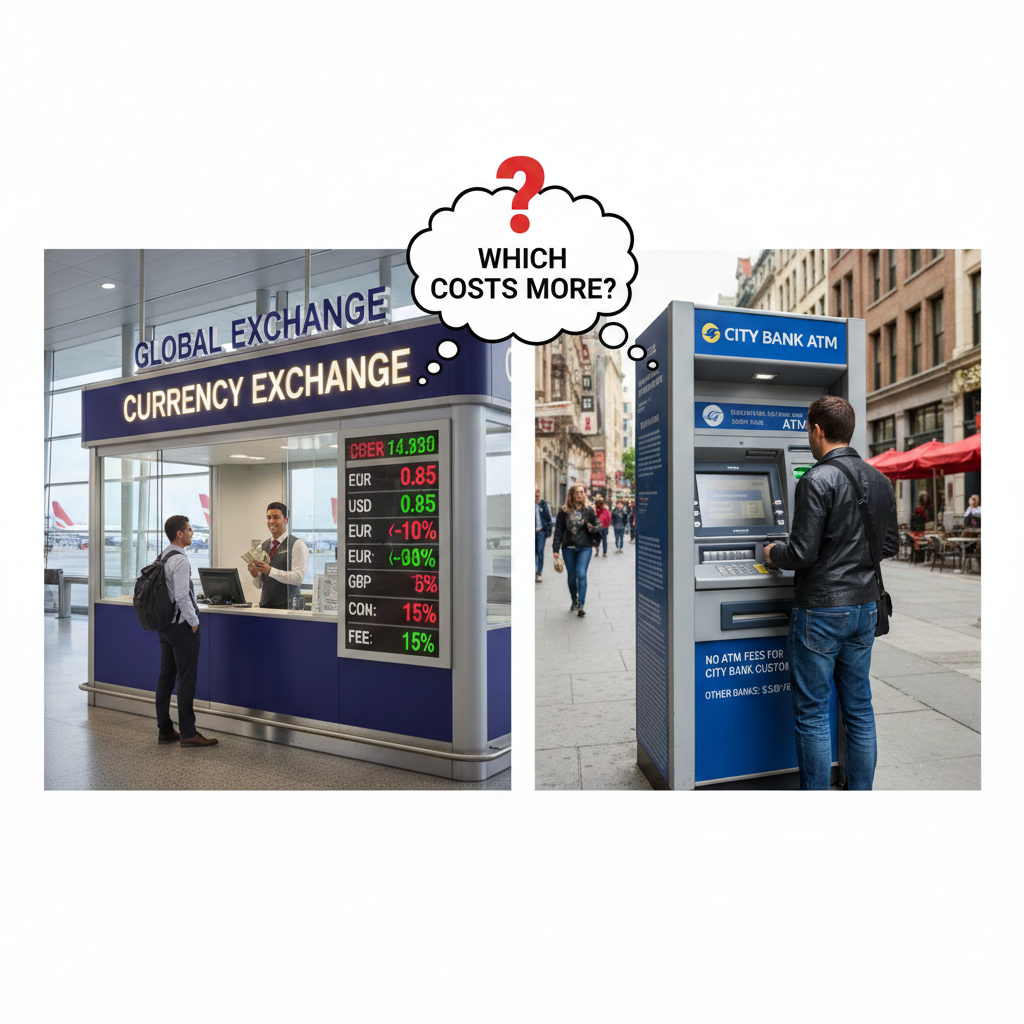
Airport Exchange vs City ATM: Which One Costs More? When comparing airport exchange vs city ATM, airport exchange counters almost always cost more—sometimes dramatically more. The difference isn’t just a visible fee; it’s the exchange rate markup hidden inside the transaction. City ATMs, especially those run by major banks, usually give rates much closer to the real market price.
This matters because many travelers lose money in their first hour abroad. After a long flight, convenience feels worth it—but those “no commission” airport signs often mask some of the worst rates you’ll see all trip. Understanding where the extra cost comes from helps you avoid a mistake that quietly drains your budget before your vacation even begins.
FAQs Airport Exchange
Conclusion Airport Exchange

- The Short Answer (Featured-Snippet Ready)
Airport exchange counters almost always cost more than city ATMs because they use wide exchange-rate markups, while bank-run city ATMs usually convert currency at near-market rates.
- Why Airport Exchange Counters Are Expensive
Airport exchange counters operate in a perfect environment for overcharging:
travelers are tired,
options are limited,
urgency is high.
Even when they advertise “0% commission,” the exchange rate itself is often far worse than the market rate. That hidden spread is where the real cost lives.
What makes airport rates worse
low competition,
captive customers,
opaque pricing.
[Expert Warning]
“No commission” does not mean “cheap.” It often means the fee is buried in the rate.
- How City ATMs Usually Price Currency
City ATMs—especially those operated by large banks—typically allow your own bank or card network to handle the conversion. That’s the key advantage.
When this happens:
the rate is usually close to the interbank rate,
fees are clearer and smaller,
transparency improves.
The most important rule:
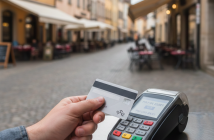
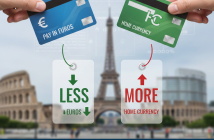
Always withdraw in euros, never in your home currency.
Choosing your home currency triggers dynamic currency conversion, which is one of the most expensive mistakes travelers make.
[Pro-Tip]
If an ATM asks which currency to use, choosing EUR almost always saves money.
- The Hidden Role of Spreads and Markups
Most travelers look for visible fees. But the biggest cost difference between airport exchanges and ATMs is the spread.
What is the spread?
The spread is the gap between:
the real market exchange rate, and
the rate you’re offered.
Airport counters often use extremely wide spreads. City ATMs usually use much tighter ones.
A wide spread can cost:
3–10% of your money,
without showing up as a “fee.”
That’s why airport exchanges feel painless—but are expensive.
- Convenience vs Cost: The Real Trade-Off
Airport exchange counters sell speed and certainty, not value.
For some people, paying more feels acceptable if it avoids stress. The problem is that the cost is rarely obvious. Many travelers would choose differently if they understood the real difference.
If you’re exchanging:
a small emergency amount → cost difference is limited
a larger sum → cost difference compounds fast
[Money-Saving Recommendation]
If you must exchange at the airport, convert the minimum amount needed and use a city ATM later for the rest.
- Information Gain: Why Airports Can Charge More
Most articles say “airports are expensive” but don’t explain why.
Airports function like a monopoly environment:
limited physical space,
controlled access,
fixed foot traffic.
Exchange providers pay high rent and face little competition—so they price accordingly. The traveler ends up paying for that structure, not just the service.
Understanding this explains why airport rates stay bad year after year. It’s not an accident—it’s the business model.
- Practical Table: Airport Exchange vs City ATM
| Feature | Airport Exchange Counter | City Bank ATM |
| Exchange rate | Very poor | Near market |
| Transparency | Low | Moderate to good |
| Visible fees | Often none | Small or none |
| Hidden spread | Very high | Low |
| Convenience | Very high | High |
| Best use case | Emergency only | Main cash source |
- Common Mistakes and Fixes
Mistake 1: Exchanging all cash at the airport
Fix: Exchange the minimum, then use a city ATM.
Mistake 2: Trusting “no commission” signs
Fix: Compare rates, not slogans.
Mistake 3: Using private tourist ATMs
Fix: Look for bank-branded machines.
Mistake 4: Accepting DCC prompts
Fix: Always choose EUR.
[Expert Warning]
The most expensive currency exchange is the one done in a rush.
- UNIQUE SECTION — Real-World Travel Scenario
You land late at night. Everything feels closed. An exchange booth is open and promises “no fees.”
You exchange a large amount because it feels safer.
The next day, you see a bank ATM offering a far better rate just a few blocks from your hotel. The difference isn’t obvious—but it’s already gone.
This scenario repeats daily in every major European airport.
- Step-by-Step: Cheapest Arrival Strategy
Before traveling, ensure your card works abroad
Carry a small amount of home currency backup
If needed, exchange a very small amount at the airport
Find a bank-branded ATM in the city
Withdraw in euros only
Decline any conversion offers
This approach balances convenience and cost.
YouTube Embed (Contextual & Playable)
Embed an educational explainer such as:
“Airport Currency Exchange vs ATM: Which Is Cheaper?”
Choose a travel-finance or consumer-education channel that explains spreads and DCC clearly.
- FAQs (Schema-Ready)
Is airport exchange ever worth it?
Only for small emergency amounts.
Are airport ATMs better than exchange counters?
Sometimes—if they are bank-operated and not private.
Why do airport exchanges hide fees?
They charge through the exchange rate spread.
Do city ATMs always offer better rates?
Usually, but avoid private tourist ATMs.
What if I arrive at night?
Exchange a minimal amount, then use a city ATM later.
- Conclusion
When comparing airport exchange vs city ATM, city ATMs almost always win on cost. Airport exchange counters thrive on convenience and urgency, not fairness.
If you understand spreads, avoid dynamic currency conversion, and plan for a city ATM withdrawal, you’ll consistently pay less for euros. A little patience on arrival can save more money than chasing exchange-rate timing all week.
internal link
external link
https://quickcurrency.net/blog/airport-exchange-vs-atms-vs-banks.html?utm_source