introduction
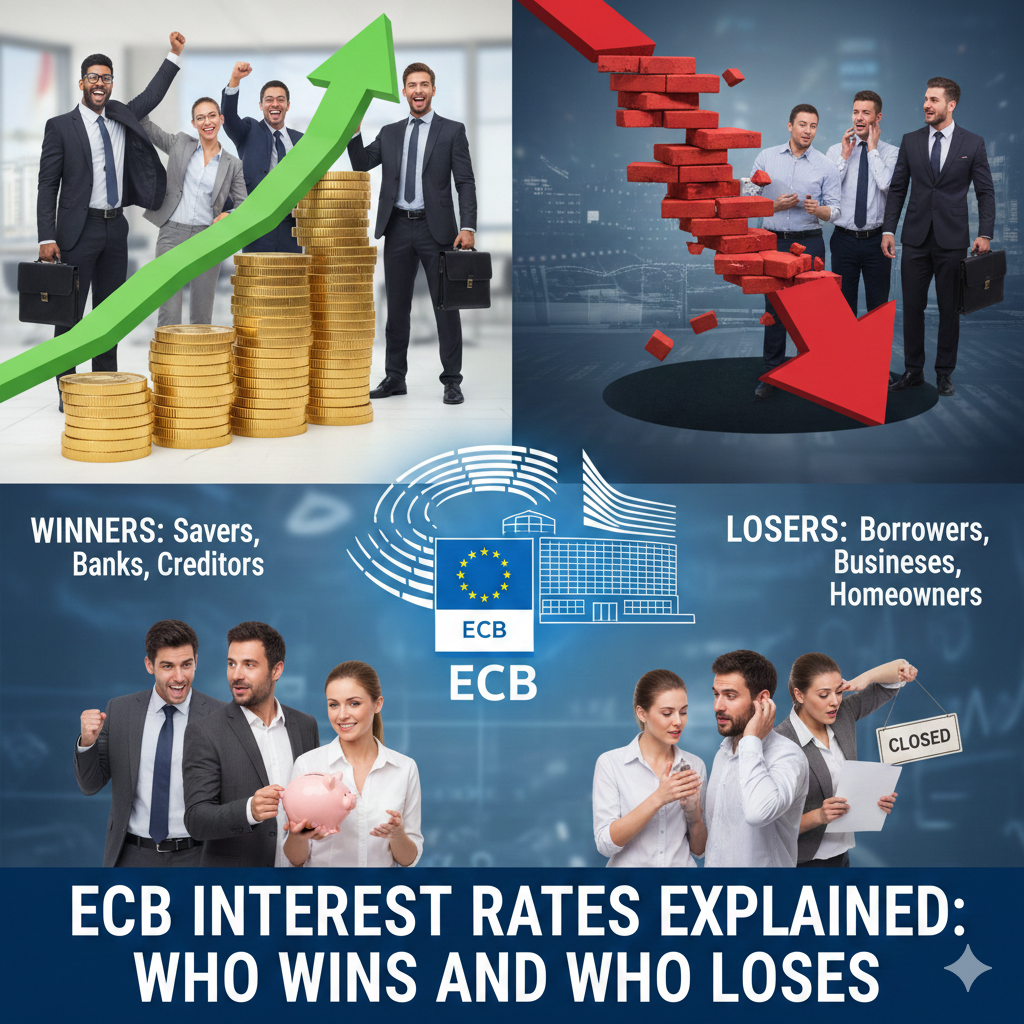
Interest Rates decisions don’t affect everyone equally. When rates rise or fall, some groups benefit while others struggle, often at the same time. The confusion comes from hearing that higher rates are “good for inflation” while households feel more financial pressure.
This topic matters because ECB rate changes influence mortgages, savings, government debt, business investment, and even job security. Understanding who wins and who loses helps you interpret eurozone news more clearly—and avoid assuming that a single policy move is universally good or bad.
Table of Contents

The short answer (featured snippet)
What ECB interest rates actually control
Who benefits when rates rise
Who suffers when rates rise
Who benefits when rates fall
Who suffers when rates fall
Information Gain: why rate policy always creates trade-offs
Practical table: winners and losers by rate cycle
Common misconceptions
UNIQUE: Real-world rate hike scenario
How to interpret ECB rate decisions
FAQs
Conclusion
The Short Answer (Featured-Snippet Ready)
ECB interest rate changes create clear winners and losers: higher rates help savers and control inflation but hurt borrowers and growth, while lower rates support borrowers and investment but reduce savings income and risk inflation.
What ECB Interest Rates Actually Control
ECB interest rates influence:
borrowing costs across the eurozone,
returns on savings and deposits,
credit availability for businesses,
government debt servicing costs.
They do not directly set prices or wages. Instead, rates work by changing incentives—how easy or expensive it is to borrow, spend, and invest.
[Expert Warning]
Interest rates influence behavior gradually, not instantly.
Who Benefits When Rates Rise
Higher interest rates tend to benefit:
Savers
higher returns on savings accounts,
better yields on low-risk investments,
improved purchasing power protection.
Long-Term Price Stability
slower demand growth,
reduced inflation pressure,
more predictable pricing environment.
Financial Discipline
less speculative borrowing,
more careful investment decisions.
For savers who relied on near-zero rates for years, higher rates can feel like overdue relief.
Who Suffers When Rates Rise
Higher rates create pressure for:
Borrowers
higher mortgage payments (especially variable-rate),
increased consumer loan costs,
reduced affordability.
Businesses
more expensive financing,
delayed expansion plans,
tighter credit conditions.
Governments
higher debt servicing costs,
less fiscal flexibility.
[Pro-Tip]
Rate hikes hit variable-rate borrowers first—and hardest.
Who Benefits When Rates Fall
Lower interest rates tend to benefit:
Borrowers
cheaper mortgages and loans,
easier refinancing,
improved cash flow.
Businesses
lower capital costs,
increased investment activity,
stronger hiring incentives.
Governments
cheaper debt financing,
more room for fiscal support.
This is why rate cuts are often used during economic slowdowns.
Who Suffers When Rates Fall
Lower rates can harm:
Savers
reduced interest income,
pressure to take more risk,
erosion of real returns.
Asset Price Stability
inflated property and stock prices,
increased speculative behavior.
Long-Term Inflation Control
risk of demand overheating,
difficulty reversing policy later.
[Money-Saving Recommendation]
Savers should focus on real (inflation-adjusted) returns—not headline yields.
Information Gain: Why Rate Policy Always Creates Trade-Offs
A common misconception is:
“There must be a ‘correct’ interest rate.”
In reality, every rate level favors one group over another.
The ECB’s challenge is balancing:
inflation control vs growth,
savers vs borrowers,
short-term pain vs long-term stability.
This is why rate decisions are controversial—even when economically justified.
Practical Table: Winners and Losers by Rate Cycle
| Rate Direction | Winners | Losers |
| Rates rising | Savers, inflation fighters | Borrowers, leveraged firms |
| Rates falling | Borrowers, investors | Savers, income-focused households |
| Rates stable | Planning certainty | Speculators |
- Common Misconceptions
Misconception 1: Higher rates are always bad
→ They control inflation and reward saving
Misconception 2: Lower rates help everyone
→ They punish savers
Misconception 3: Rate effects are immediate
→ Impacts lag over time
Misconception 4: ECB rates control everything
→ Structural issues matter too
[Expert Warning]
Interest rates are powerful—but not all-powerful.
UNIQUE SECTION — Real-World Rate Hike Scenario
A household with:
a variable-rate mortgage,
limited savings,
fixed income,
feels immediate pressure when rates rise.
Meanwhile:
a saver with low debt,
stable income,
cash deposits,
benefits from higher returns.
Same policy. Completely different outcomes.
How to Interpret ECB Rate Decisions
When the ECB changes rates:
Ask what problem they’re addressing
Identify who absorbs the cost
Look for forward guidanc
Expect delayed economic impact
Separate politics from economics
This framework reduces emotional reactions to rate headlines.
YouTube Embed (Contextual & Playable)
Embed an explainer such as:
“How Central Bank Interest Rates Affect the Economy”
Choose a neutral economics-education channel focused on cause-and-effect, not opinion.
FAQs (Schema-Ready)
Do higher rates always reduce inflation?
Usually, but with time delays.
Why doesn’t the ECB protect borrowers?
Its mandate prioritizes price stability.
Are savers always better off with higher rates?
Only if rates exceed inflation.
Can rate cuts cause inflation?
Yes, if demand grows too fast.
How fast do rate changes affect households?
Variable-rate borrowers feel it first.
Conclusion
ECB interest rate decisions shape the eurozone economy through trade-offs. There are always winners and losers—depending on debt levels, savings, and economic position.
Understanding these dynamics helps you move beyond emotional reactions to rate changes. Instead of asking whether a decision is “good” or “bad,” the better question is: good for whom—and at what cost?
Internal link
External link
https://www.ecb.europa.eu/ecb%E2%80%91and%E2%80%91you/explainers/html/interest%E2%80%91rates%E2%80%91changes.en.html