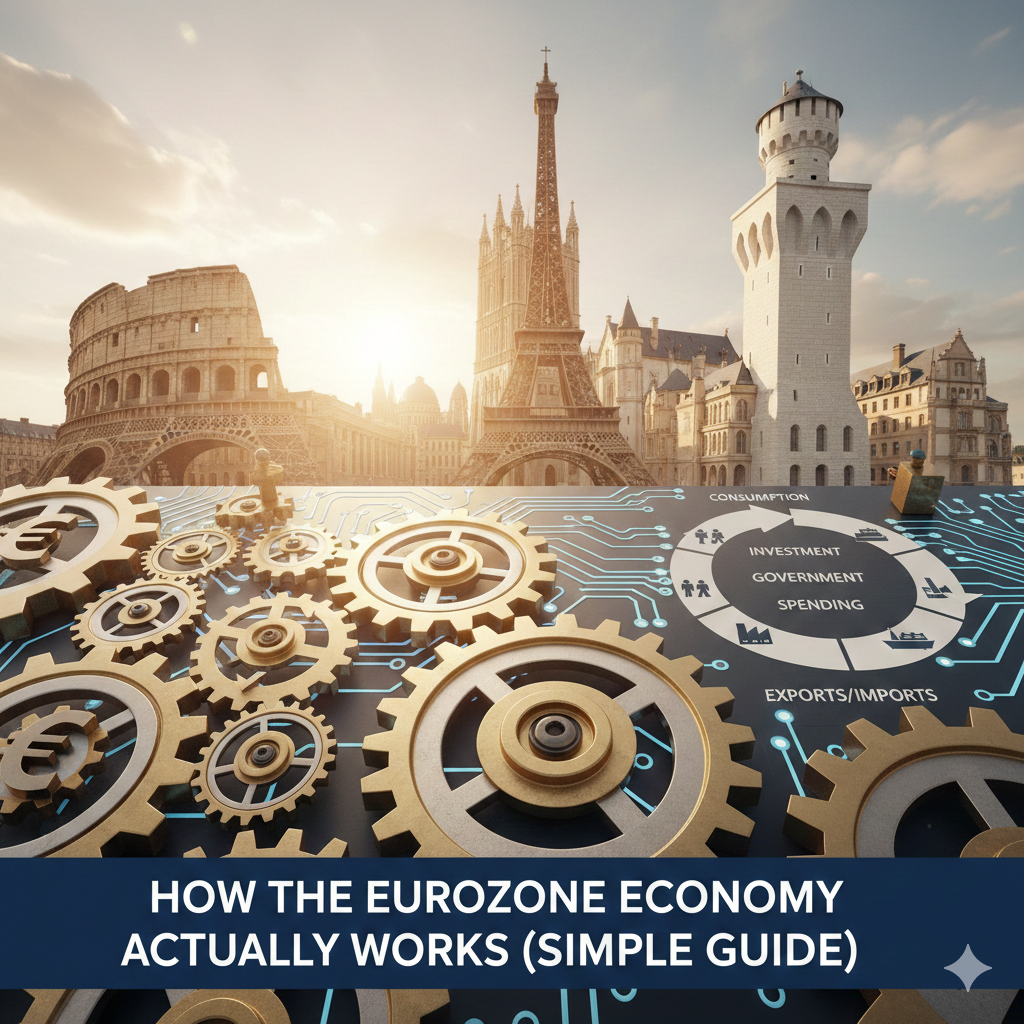
This topic matters because many people assume the eurozone operates like a single country. It doesn’t. Understanding how the system is built helps you make sense of inflation decisions, growth differences between countries, debt debates, and why the same policy can help one country while hurting another. Once you understand the mechanics, eurozone news becomes far easier to interpret.
-
The Short Answer (Featured-Snippet Ready) Eurozone Economy
The eurozone economy works by sharing a single currency and central bank across multiple countries, while each country keeps control over taxes, spending, and labor policy—creating coordination benefits and unavoidable trade-offs.
-
What the Eurozone Actually Is
The eurozone is a group of European countries that:
use the euro as their currency,
share a central monetary authority,
coordinate economically—but do not merge politically.
Each country joined voluntarily, agreeing to give up its national currency in exchange for:
lower transaction costs,
price stability,
deeper economic integration.
What they did not give up is just as important.
- One Currency, Many Economies
This is the eurozone’s defining feature.
Germany, Italy, Spain, France, and others all:
use the same currency,
borrow in the same unit,
face the same interest rates.
But they have:
different productivity levels,
different labor markets,
different demographic pressures,
different growth models.
A policy that fits one economy perfectly may strain another.
[Expert Warning]
The eurozone is unified by currency—not by economic uniformity.
- Who Controls Monetary Policy
Interest rates, inflation targets, and money supply are handled centrally.
This means:
one interest-rate decision affects all member countries,
currency value is managed for the entire bloc,
individual countries cannot devalue or print their own money.
This centralization increases credibility and stability—but removes a traditional adjustment tool for struggling economies.
- What Countries Still Control Themselves
Despite shared money, eurozone countries control:
government spending,
taxation,
social programs,
labor laws,
pension systems.
This leads to very different outcomes under the same monetary conditions.
For example:
low rates may boost exports in one country,
while fueling housing inflation in another.
[Pro-Tip]
When reading eurozone news, always ask: “Which country benefits from this policy?”
- Why Economic Growth Differs Across the Eurozone
Growth differences exist because:
economies specialize in different industries,
demographics vary widely,
reform pace differs by country.
Export-driven economies respond differently to global demand than service-heavy ones. Aging populations react differently to inflation than younger ones. These structural factors matter more than headlines.
- Information Gain: The Core Tension Inside the Eurozone
Most articles say the eurozone is “complex.” Few explain why.
The core tension is this:
Monetary policy is shared, but economic responsibility is national.
This means:
countries can’t adjust currency to regain competitiveness,
fiscal disipline matters more than ever,
coordination requires constant negotiation.
This tension isn’t a flaw—it’s the price of integration.
- Practical Table: Who Controls What
| Area | Controlled By |
| Currency value | Eurozone-wide |
| Interest rates | Central authority |
| Inflation target | Central authority |
| Taxes | National governments |
| Government spending | National governments |
| Labor laws | National governments |
- Common Misunderstandings
Misunderstanding 1: The eurozone is one economy
→ It’s many economies sharing money
Misunderstanding 2: All countries grow together
→ Cycles differ by structure
Misunderstanding 3: Countries can print euros
→ They cannot
Misunderstanding 4: Policy moves affect everyone equally
→ Effects vary widely
[Expert Warning]
Uniform policy does not produce uniform results.
- UNIQUE SECTION — Real-World Policy Example
When interest rates rise:
highly indebted countries feel pressure quickly,
export-heavy countries may cope better,
households with variable-rate loans feel pain sooner.
The same rate hike stabilizes inflation—but distributes stress unevenly. This is why eurozone debates are often intense but slow moving.
H2: How to Read Inflation News by Country
When you see a headline:
Identify whether it’s monetary or fiscal
Note which countries are most affected
Separate political reaction from economic effect
Watch long-term trends, not single announcements
This approach filters noise from signal.
YouTube Embed (Contextual & Playable)
Embed an explainer such as:
“How the Eurozone Works Explained Simply”
Choose an economics-education channel that focuses on structure, not opinion.
H2: FAQs About Inflation in the Eurozone
Is the eurozone the same as the EU?
No—some EU countries don’t use the euro.
Can eurozone countries leave the euro?
In theory yes, but it’s economically complex.
Who sets interest rates for the eurozone?
A central authority for all members.
Why do some eurozone countries struggle more?
Structural differences, not currency alone.
Does the euro help or hurt growth?
It helps stability but limits flexibility.
H2: Conclusion
The eurozone economy works because of coordination—not uniformity. A shared currency brings stability, efficiency, and integration, but it also requires compromise and patience.
Once you understand who controls what—and why outcomes differ—you stop seeing eurozone news as chaotic. Instead, it becomes a system with clear rules, predictable tensions, and long-term logic.
Image Suggestions (1200 × 628 px)
Featured Image Prompt
Create a clean editorial image showing a map of the eurozone with interconnected economies sharing one euro symbol at the center. Use professional blue-gray tones, minimal icons, and title text: “How the Eurozone Economy Works”.
Internal link
External link
https://commission.europa.eu/topics/economy-and-euro_en?utm_source=